Wednesday, March 18, 2020

What Happened To Arthur?

My Grandfather died a very long time ago. He died when my Dad was only 11 months old, so they never knew each other. Whatever I learned about my Grandfather, I received from my Aunts who were young women when he passed in 1925.
There were many family stories and beliefs about Arthur D Curtiss that I have found not to be true. Over the last 15 years I have dug into my family genealogy and history following the paper trail to where ever it took me. I discovered the true facts about the death of Arthur because I actually contacted the hospital where he passed away and had them photo copy his records for me. What I found dispelled one very mysterious family legend as to the cause of his death.
I have also discovered things that I think my dear deceased Aunties didn't even know. Things that occurred before they were born. It seems that my Grandparents possibly started their marriage on a very shaky foundation.
As per my usual searching routine, I happened upon I newspaper article dated Wed, May 23, 1906 from the St. Joseph News-Press/Gazette. Page 5
"A. D. CURTISS LEAVES
Street Railway Conductor Deserts Wife of Ten Months"
Oh my gosh. This was a shocking article to say the lease. Here it was for all of St Joe, Missouri to read about. After 10 months of marriage something caused Arthur to temporarily bolt from his wife and run away. He was almost 25 years old. He had a good job working as a Streetcar Conductor. Why would he write a note and leave it under the door saying he couldn't live happily with his wife anymore?
The article said the my Grandmother was very sick at the time. I returned to my family tree and found that she wasn't sick in any sense of the word. She was however very pregnant and about to give birth to her first daughter in July. I was beginning to get the picture of what was really going on with Arthur. This was all happening too fast for him to process. A new wife added more responsibility. Now a baby on the way adding even more pressure and responsibility. He must have been feeling somewhat overwhelmed and possibly trapped. He couldn't take the pressure.
But there was a twist to the story. The article also said that his friends thought he had committed suicide! He had told a friend recently he wanted to throw himself into the Missouri River and end it all. Maybe he could go into a state hospital if he acted crazy enough. His friends tried to make light of his talk by teasing that he might not actually be able to stay out of the asylum the way he is!  Running away and committing suicide are two different things! I believed something more than the normal pressures of a new family were at work here. I'm happy to report that he did not commit suicide but returned home at some point as I have census records and photos of them together. There was no follow-up article.
Arthur did in the end die in a State Hospital. His cause of death: Paralysis of the Insane.


Monday, February 18, 2019

Edward H Curtiss Memorial Service


December 14, 2018 - South Tulsa Baptist Church

The Memorial Service for Edward H Curtiss was a wonderful celebration of a life well lived. 

Edward H. Curtiss  1924 – 2018 by Jeffrey S. Curtiss
Of all the things that I could say today about my dad, I want to say that my prayer is that I finish my life as well as he finished his.
I knew him from July of 1953 until a week ago Tuesday, but his life began in 1924, three decades before mine.
He was the only son of a single mom who was widowed when he was just an infant.
She raised him and his three older sisters, the youngest of whom was 12 years his senior, during the great depression years of the 1930’s.
During those difficult years his mom baked and sold cakes and pies out of their home to help support the family.
As a child, the most influential men in his life were his brothers-in-law, particularly Elvin Drake the husband of his Sister, Ethaline. Elvin was 21 years older than my dad.
As a youngster, Dad spent his after-school hours and weekends working in a gas station owned by a cousin, and he spent many of his summers working as a counselor at the Big Bear Boys Camp in Big Bear Lake, California where his brother-in-law, Elvin was a director.
His early life and his teen years weren’t all that much different or outstanding from any other young person of his time or even of our day.
However, in the summer of 1942 at the age of 18 my dad went to war in answer to this nation’s call. He fought alongside the hosts of young men and women that now comprise what we call, “The Greatest Generation”.
His tour of duty in the war was spent aboard a destroyer escort, guarding convoys of supply and troop-bearing ships as they transited the Atlantic Ocean between the U.S., Europe, and Africa. When not on convoy duty his ship’s assignment was to hunt German submarines up and down the east coast and in the Caribbean Sea.
When the war in Europe ended, he was reassigned to a destroyer in the Pacific Theater where they saw no combat action but took part in the first atmospheric tests of the newest and deadliest weapons ever developed my man. My dad was an eyewitness to four atom-bomb tests at the Bikini and Eniwetok Atolls as a participant in Operation Crossroads.
He had had an interesting and adventurous life, but in 1948 his life took a dramatic turn.
My dad entered the Navy as an idealistic high school graduate of 18. Six years later he was a battle-tested, world-traveled sailor. In those six years he had been tested as only the military and war can test a young man. During his service with the Navy he had seen man and nature at their best, and at their absolute worst.
Having personally served in the Navy I understand that military life in a time of war can shape your worldview into something a bit more jaded than most people’s, but when my dad heard the salvation message, and the story of Jesus Christ, he re-set the course of his life toward Jesus and never looked back.
Of all the great stories my father told us as we grew up, none were told with as much heart and enthusiasm as when he related the change in his life between the night, he asked Jesus Christ to be his Lord, and the next morning when he awoke to an entirely new and vibrant world. My dad was radically saved. II Corinthians 5:17 says, “Therefore, if anyone is in Christ, he is a new creature; the old things passed away; behold, new things have come. My dad experienced that change and it thrilled him.
From the day he was saved until his last trip to the hospital, my dad was a voracious, ardent, insatiable student of Bible; always learning, always seeking; but he also put what he learned into practice. If you knew my dad for even the shortest time you knew that he was a follower of Jesus Christ. You knew that by the way he treated people, and because very soon after he met someone, he would ask them if they knew Jesus too. If they didn’t, he would make sure that they heard the story of Jesus and what Jesus meant to him, and what Jesus has done for them.
My dad loved people, he was a people person. It didn’t matter if you were a follower of Christ or not, his home; our home was always open to folks he met along life’s way.
A number of the people sitting here in these pews were young adults that my dad and mom met and folded into our family. Attorneys, accountants, flight attendants, artists, secretaries, musicians, air traffic controllers, foreign exchange students; they run the gamut, and some, now as many as four decades later, are still considered a part of our  family. And the ones who are family to us share our common bond of faith in Jesus Christ. Some of them share that bond because of the testimony of my father and mom, and the love of Jesus that flowed, and flows, through them.
You, know, I don’t recall ever hearing my dad refer to himself as a member of any denomination, or even as a Christian. If asked, he would tell you what church he attended, but my dad always told people that he belonged to Jesus Christ. That was his identity. Dad was a lot of things; Husband, friend, father, engineer, WWII veteran, wood worker, award-winning photographer, hunter, fisherman, outstanding grandfather, and great grandfather, but he found his purpose and his significance, in his Savior and everything about him flowed from that.
My father was a wonderful man but he was not without his faults. When you spend a lifetime with someone you see those faults, but when you know that this person loves you without condition those things about them that may be irritating, or quirky, or even funny don’t really matter, and matter even less with the passing of time, as you watch them run their race with patience, and in rock-solid faith that God is indeed working all things together for good to those who love Him and belong to Him, and are called according to His purpose.
When I look at the whole of my father’s life, I can clearly see the hand of God accomplishing His perfect work through the use of an imperfect, but wholly committed man.
I could tell you lots of very funny and great stories about my father, Edward H. Curtiss, but my purpose today is to honor him for who he was as his core.  His achievements and accomplishments are many; some of them are significant on a very grand scale, but I think that I can best honor him by telling you what I know he would want you to know about him.
In summer of 1948, in San Diego, California, just before he was honorably discharged from his service to his country, my dad said yes to Jesus, and then began to discover the simple and unalterable truth of the faithfulness of God and the rock-solid truth of His word.
I want to leave you with three short passages that I know my dad would give to you if he were standing here in my place instead of me in his. The first is, in a very real sense the key that can, if you choose to use it, unlock every one of life’s door you ever encounter.
Psalm 37:3, Delight yourself in the Lord; and He will give you the desires of your heart. My dad wisely took God up on that offer and found it to be true. By the way, that word, delight, means to get to know God like someone with whom you find yourself falling in love, because you will fall in love with Him. My dad loved God with all his heart.
The second is from the book of Proverbs, chapter 3, verses 5 and 6.
Trust in the Lord with all of your heart, and don’t depend on your own ability to understand. Do everything as though He was standing right beside you, and He will direct your pathway.
The third is a pair of verses that my dad often prayed back to God during his last days. They are from Psalm 73, verses 25 and 26.
25 Whom have I in heaven but You?
And besides You, I desire nothing on earth.
26 My flesh and my heart may fail,
But God is the strength of my heart and my portion forever. Psalm 73:25-26
. That was his testimony during the worst of his last days.
We miss Dad terribly. We are grieving, but not without hope. We are feeling the pain of separation but not of loss, because we know that my dad is more alive today than he has ever been, and that we are going to see him again, maybe soon – who knows.
Allow me to leave you with this, the words of Job, a man of incredible faith; who knew unbelievable suffering but never lost his faith.
Here is what he had to say in the midst of his incredible pain and loss. He spoke of the future, bodily resurrection to eternal life, of everyone that places their hope and trust in God and His son Jesus Christ.
25 “As for me, I know that my Redeemer lives,
And at the last He will take His stand on the earth.
26 “Even after my skin is destroyed,
Yet from my flesh I shall see God;
27 Whom I myself shall behold,
And whom my eyes will see, and not another. Job 19:25-27
That is how my dad lived his life, knowing that his Redeemer lives. And I know that it is a hope that he, and we would love to share with each of you.
On behalf of myself and my family; we thank you from the bottom of our hearts for coming here today to honor my father.


The front and inside of the Memorial Card / handout given to the friends and family who attended the Memorial Service.
This is the Video of the Military Honor Guard who volunteered to Honor Edward H. Curtiss for his 6 year service during WWII. 


Sunday, May 6, 2018

CURTISS FAMILY in the NEWS - 1872

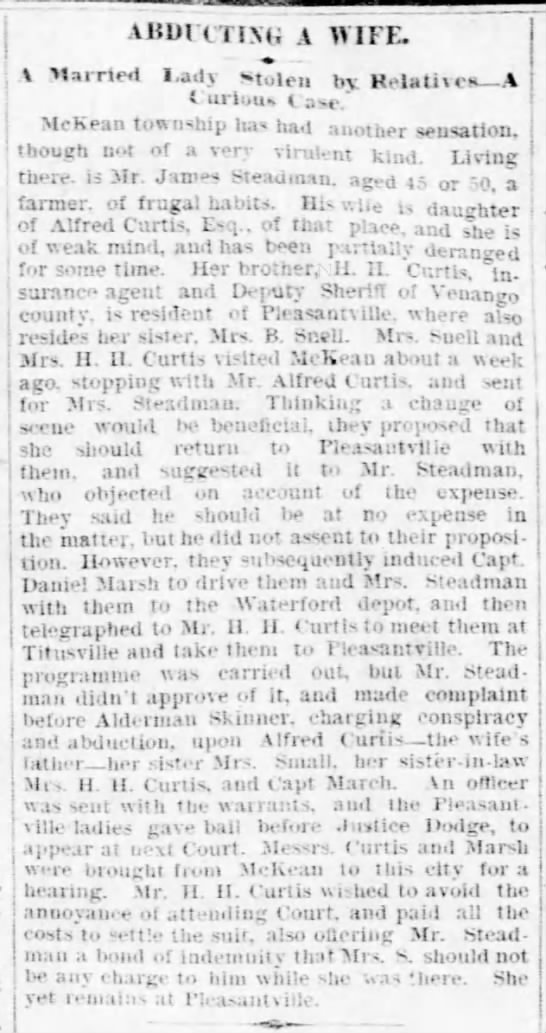
Here is a story I found while searching for Curtiss news via newspapers.com. The story as it appears in print is very hard to read due to poor quality so I transcribed it.

It appears that the siblings of  L. Rebekah Steadman (nee Curtiss b.1819) thought it wasn't healthy for her to stay with her husband James Steadman III in McKean, PA. At age 53 she was most likely going through menopause and acting crazy.


Pittsburgh Weekly Gazette (Pittsburgh, Pennsylvania) - 29 May 1872, Wed. - Page 4

ABDUCTING A WIFE
A Married Lady Stolen by Relatives – A Curious Case

McKean Township has had another sensation, thought not of a very virulent kind. Living there is Mr. James Steadman age 45 or 50, a farmer, of frugal habits. His wife is daughter of Alfred Curtis, Esq. of that place and she is of weak mind, and has been partially deranged for some time. Her brother, H. H. Curtis, insurance agent and Deputy Sheriff of Venango county is resident of Pleasantville where also resides her sister, Mrs. B. Snell (Small). Mrs. Snell and Mrs. H. H. Curtis visited McKean about a week ago, stopping with Mr. Alfred Curtis, and sent for Mrs. Steadman. Thinking a change of scene would be beneficial they proposed that she should return to Pleasantville with them and suggested it to Mr. Steadman. who objected on account of the expense. They said he should be at no expense in the matter, but he did not assent to their proposition. However, they subsequently induced Capt. Daniel Marsh to drive them and Mrs. Steadman with them to the Waterford depot and then telegraphed to Mr. H. H. Curtis to meet them at Titusville and take them to Pleasantville. The programme was carried out, but Mr. Steadman didn’t approve of it and made compliant before Alderman Skinner, charging conspiracy and abduction upon Alfred Curtis -- the wife’s father – her sister Mrs. Small, her sister in-law Mrs. H. H. Curtis, and Capt. March.  An officer was sent with warrants, and the Pleasantville ladies gave bail before Justice Dodge, to appear at next Court. Messrs. Curtis and Marsh were brought from McKean to this city for a hearing.  Mr. H. H. Curtis wished to avoid the annoyance of attending Court, and paid all the costs to settle the suit, also offering Mr. Steadman a bond of indemnity that Mrs. S. should not be any charge to him while she was there. She yet remains at Pleasantville.

The Family: 
Alfred Curtiss (b. 1797)
Loeza Rebekah Curtiss (b. 1819) married to James Steadman III (b. 1815 England)
Henry Hatch Curtiss (b. 1829) married to Varilla W. Waid (b. 1833)
Lovina Belinda Curtiss (b.1823) married to Robert  A. Small (b. 1823)

Alfred Curtiss & Family. - j AKUrtTIN A WIFE. ; A Marrted Lady stolen bv...


Sunday, October 22, 2017

Seeking Curtiss Cousins

This post is primarily an attempt to connect with my Curtiss relatives. I've added your names to this list hoping that you have done a web search of your own name or the names of your parents to see what may be out there. If you find your name in this list on this blog, you are my cousin and I would love to make a connection.  You can send an email to this blog and I can then get in touch with you. Here's the list of Cousins I've found:

Virginia Dale (Curtiss) Thorp
Rodney K. Thorp
Letitia C. Thorp (Allan, Ferry, Graybill)
Linda K. Thorp (Crandell)

Norma Dixon (Curtiss) Donat Joiner
Ronald Floyd Donat
Ronald J. Donat
Patricia Ann Joiner


HENRY HATCH CURTISS

My 2xGreat Grandfather's brother, Henry H. Curtiss was born in Crawford County, Pennsylvania 1829. His parents were Alfred and Charlotte (Hatch) Curtiss.
He married a local girl named Varilla W. Waid on the 4th of July 1849. They had four daughters named Ada Evangeline, Alma Bernice, Adelma Clarabell and little Hattie May who died by age 3.

In 1850 at age 21, Henry was a Blacksmith and lived in Randolph Township, PA, close to where his father had a farm in Guys Mills. He moved his family to Allegany Township, PA where he was farming. In 1863 he registered in the Civil War Draft Registration but did not serve. That same year Hattie May died. Henry made a career change and moved to Pleasantville, PA where he became a News Dealer. He stayed in Pleasantville for the remainder of his life which ended suddenly one night in 1878.

On the night of October 18th, Henry had invited guests to his home for dinner. Dr. William A.Glover, Miss Theresa Lay and Mary A. Lay were there in the sitting room with daughter Dell (Adelma) enjoying a conversation about the scenery in Arizona. Everyone was having a good time and according to Mary Lay, Henry was in his usual happy entertaining spirits. They mentioned some relics that they had gotten and Henry got up from his seat and went to his desk. He said he had some interesting relics from a nitroglycerine explosion to show Dr. Glover. As he pulled the bones out of his desk drawer Dell said she didn't like having them in the house as they were skull bones. They were looking at the bones and heard the sound of a pistol firing. Henry said, "Who loaded this pistol?" He got up, walked to the lounge where he had been sitting earlier and sat down. Everyone thought he had exploded something to frighten them until he slumped over on the lounge. Dr. Glover said, "I thought he had exploded something to frighten us; then I got up and just as my back was turned I heard their screams, and as I turned around I saw him falling and caught him and put him on the lounge, and found life extinct." They called for Dr. Benedict who did a full examination and found a wound in his left side. The bullet had passed through his heart. Dell said that her father "was in his usual good spirits" and that it was her pistol that was kept in the desk drawer and she had been the one to load it about a year before the accident. He apparently didn't know it was loaded when he put it back in the drawer and it fired off a round into his side. The Coroner's Inquest concluded it was an accidental shooting.


Saturday, September 6, 2014

Edward H. Curtiss - Navy History Part 2

Bikini Experience
December 15, 1947 - USS PASIG AW-3


On the way to the atoll we made a brief stop at the island of Roi. I have no conformation of the name but it is what we were told. We came to a stop and were soon joined by a smaller cargo type vessel. The big black box was off loaded onto this ship along with the security marine group. We then proceeded to Bikini, took up our assigned station and dropped anchor. The next morning ( July 26 ) we got underway and took up patrol station among all the rest of this operations ships. I cannot remember how many ships were anchored in the test area but there were a lot of them. All doomed to be sacrificed to further our country’s need to know the effectiveness of the bomb on ships at sea. The German battleship Prinz Eugen ( pronounced Yoygen) which was captured during WWII and our old retired aircraft carrier Yorktown.
We were all very nervous about this test. Thinking about the radioactivity and the force of the blast but here we were determined to make the best of it come-what-may. My normal sea detail was in the forward engine room but when the captain requested anyone that could draw sketches of the explosion should “lay up”to the bridge. This was to be an opportunity of a lifetime that I was not about to miss so up to the bridge I went. I was handed a sketch pad , a pencil and a pair of special dark glasses to protect the eyes from the intensity of the blast. When the bomb exploded it was so fascinating it took me a few minutes to get to working on the sketches but I did. They were good enough to be entered into Naval records and I got a thank you letter from the Admiral in charge of this operation. Believe me it was an unforgettable experience.

Friday, July 4, 2014

Helen Francis "Babe" (Curtiss) Conner


9 May 1912 – 14 May 2014

Helen Frances “Babe” Conner was born May 9, 1912 in Omaha, Nebraska. 

Her father was Arthur Darby Curtiss and mother Lata LaVesta Launder. Her father was a florist who did landscaping work and worked in greenhouses. 

Helen was the third child with two older sisters, Ethelyne N. Drake and Ruby L. Grandfield, both now deceased. 

In the early 1920s the family moved to Los Angeles and lived on Idaho Avenue. In 1924 Helen’s brother Edward H., whom many of you know, was born. Ed would go on to marry Helen Tollefson – and the sisters- in-law were very close friends. Sadly, Arthur Curtiss never knew his son because Arthur was in the hospital from early 1924 to mid 1925, when he died. Helen was 12 years old. 

In 1929 Ethelyne married Elvin “Ducky” Drake who was a beloved figure in UCLA athletics for his entire career – Drake Stadium was later named after him, and the players loved him. 
 
Everyone had a nickname in this family. Ruby was called “Sis”; Lauren, Ruby’s husband, was called “Red”; you heard about “Ducky”; Ed was and is called “Bud”; of course there was “Babe”.

Babe graduated from University High School. She was  in its first graduating class. She was
extremely social and had some wonderful friends. They started a high school philanthropy club called Cosmos. She graduated right around the time of the Great Depression, and after graduation, Helen worked at the Tivoli Theater on Santa Monica Blvd for 25 cents per day. 

She met her husband John Wesley Conner who of course had a nickname – he was called “Wes” - and they were married in 1931. Both ended up working for Tucker McClure, Corporation which was a General Contracting business. Wes was an electrician and Helen was an excellent secretary who was an expert in short hand. During this time, even though World War II had not started yet, Tucker McClure was building military bases, and there was a lot of military activity going on in Ecuador. Helen and Wes transferred to the jungles of Ecuador around 1933 and they would live there for almost a decade.  

Interestingly enough, the doctors had told them they would not be able to have children, and for quite some time they didn’t. But in 1943 they decided to leave Ecuador to have their first child, John, here in the United States.  Helen was VERY pregnant. On the way home from Ecuador, their plane actually crashed in Mexico because of a landing gear failure. Amazingly, no one was hurt, but there was still this little matter of getting to Los Angeles to have their baby. Fortunately, they got here just in time. 

Wes and Helen ended up having two children – John Arthur born in 1943 and David O. born about a year and half later. The doctors were wrong.  John is married to Patricia Johnson and David is married to Jill Fry. 

While back in Los Angeles, Helen continued working for Tucker McClure as executive secretary. She used to ride the red car trolley from Venice Blvd to downtown LA, where she handled the company payroll. She always made sure her kids had their lunches packed before school, and would send the kids to school before she headed off to work.  

In 1960 Tucker McClure the owner of the business, passed away, and his son Allan took over. Allan ended up closing down the business and Helen helped with that process. Allan was also really into astronomy, and Helen helped him get some of his work published. He gave Helen and Wes a telescope, and this became one of her hobbies and interests. 

However, the closing of the business meant Helen needed a new job, and so she became the executive secretary for the California State University Chancellor’s Office, from 1960 to 1974. She worked for the President of the Council.  

She finally retired in 1974, age 62.  

She and Wes’s life in retirement was extremely enjoyable. She had a lot of friends, and she was still friends with some people from Uni High School, in fact the Cosmos philanthropy club kept going up until the 1970s. They met once a month. She and Wes were also involved in a club called the Huff and Puffs which was a square dancing club. They were part of a poker club, and she was a member of the philanthropy club called PEO International.

Helen and Wes traveled all over the world including Germany, England, Australia, Ireland, they even went to China in the 1970s which was pretty much unheard of. Their favorite place was Italy. They were both healthy and able to enjoy clubs, social events and they loved having the family, including their sons, daughters-in-law, and granddaughters Samantha, Cassandra, and Alexandra, and extended family over for family dinners. Babe hosted nearly every wedding shower, baby shower, anniversary party and many birthdays for the family. 

They were blessed with good health and a fun retirement together which they enjoyed until the 1990s, when Wes Conner died in 1994 at age 87. 

Helen was a member of the West LA Methodist Church on Butler Ave, then University Bible Church on Wilshire Blvd. In the few years I knew her, she asked me to call her Helen, I think she thought it wasn’t good for the pastor to call her Babe. 

The biggest spiritual influence in her life was Community Bible Study. Helen Curtiss first invited Babe to join in the late 1970s, and she really enjoyed it. Over time, her understanding of the Bible grew and she began talking more and more about the Lord Jesus as her Savior. She was faithful in doing her lessons and homework. After a while, she was asked to serve in the leadership group, as Dottie Larson’s transcriber in shorthand, which she did even into her 90s. She would type up her notes and send them to Dottie, and those teachings would end up all over the country. Babe loved the women of CBS and it made a huge impact on her life. The other CBS women really loved her, too.

In her last years, Helen was eager to go be with the Lord in heaven. Sometimes she would wake up in the morning and say “Oh darn, I’m still here.” She had no doubts about where she would spend eternity, not because she was a good person but because she had faith in God’s Word, that whoever truly calls upon and believes in the Lord Jesus Christ will be saved. Well, she’s finally there.
 

Her Memorial Celebration was held at the Woodlawn Cemetery in Santa Monica, California May 28, 2014. 
 
Eulogy by Rev. Rob Brooks, University Bible Church

Sunday, March 10, 2013

Helen Francis Curtiss Conner

Helen Francis "Babe" & her Mother c1919.
Helen Francis Curtiss Conner is known as 'Babe' to her friends and family. She was born 100 years ago on the 9th May 1912 in Omaha, NE to parents Arthur D. and Vesta Curtiss. She is the youngest daughter of 3 girls and has a little brother Edward. 
Her family moved to Los Angeles when she was about 7 years old and she has lived there her entire life.
She was married to John Wesley "Wes" Conner for 63 years and has two sons, John Arthur Conner and David O. Conner of Los Angeles and Havasu, AZ. 
She worked as a stenographer for the UC Board of Regents until she retired. 

Babe's family and friends gathered at her home in West LA on May 12, 2012 to celebrate her and shower her with much love and affection. She thanked everyone for coming and said that she was grateful to God for the wonderful life He has given her. She made a joke and said that "time has passed so quickly since I was 80 cause I can't remember the last 20 years!" Everyone toasted her with champagne.

Saturday, January 12, 2013

EDWIN HENRY CURTISS (Part 2)


An Unhappy Ending
Edwin Curtiss c1897
“Pursuant to your request, please find enclosed copies of the Coroner paperwork on the above referenced case” read the cover letter I received attached to a bulk of papers.  I had almost forgotten about sending my letter to Kern County, CA Sheriff’s Office last October and was surprised when a thick envelope appeared in my mailbox yesterday. 
I had found evidence leading me to the suicide death of my Great Uncle Edwin Curtiss in 1932 in Kern County outside Bakersfield, CA.  The words, “white man, probably Ed Curtiss” and other coincidental references caused me to believe this was my Uncle Edwin’s death certificate.  When I reviewed the certificate I learned there was an inquest held into his death to make sure it was not murder.  
Included in the packet was a report titled INVESTIGATION OF DEATH OF ED or E. H. CURTISS.  Apparently, the Sheriff’s had interviewed his Ex-wife,  his Landlord,  a friend and his ex-wife’s brother to find out what they knew in regards to his emotional disposition in the weeks prior to his death.  Everyone, except Alice, believed he was depressed, despondent and capable of the act.  His landlord also knew he owned a gun.  One remembered him saying, “I think I will get in my car and drive down to the ocean and end it all”, and another “Well, you’ll never see me again. Only mother will know.”
His ex-wife Alice (Reeder) Curtiss whom he called by her middle name Leota, “doubted if Curtiss had committed suicide. She made arrangements to come to Bakersfield, but on the morning of May 6, 1932  . . . she had received a letter from Curtiss . . . had changed her opinion and was satisfied that he had killed himself”.  A photo copy of the hand written letter was included in the report.


Here’s what the letter read:
“My Dear Leota,
By the time this reaches you I will be in no need of help and I want you to read it over, and sit down, and pray  for me, as I have done many times for you, and I have asked you to forgive me, and you kept silent. I didn't want you to live with me, just to say you forgave me, but now see what has happened, and as I write this I’m lonesome, and blue, no money, no house (home), no work, and no one to confide in, so why struggle on longer. I have asked God many times for advice and he has not pointed out a different life for me. I am in good health, but oh so hungry for food, and a kind word, I can’t longer go on.
Alice Leota in 1918
I have told Will (Reeder) about our life a long time ago, also about Feb. 20, 1911 (their wedding date), and that I was sorry and wanted to be forgiven. As I had always tried to do the right thing by you. He said your law suit cost you $250. You sure wanted it bad didn't you? Well I hope you are a good Bridge player by now dear.
I am writing this the same also the papers, as I want my side known also. It has been a one sided affair up to now. When what is left is found you will believe me when I say that I still love you and want you to forgive me and God bless you. I have been told only a coward would do such a thing. Just try it and see if a coward could. Now dear will you please pray. 
(This part of the letter has the left side missing)
“… a very dear friend ….have known for about …I was out with her …just the same type  … dear Norma (Tisher, first wife who died) was.  … no work and no money … go on, I just can’t  …er, all she will have…it.   ..ear if you care to know …ow I feel toward you … the song, “The Red ....lley and read it every ...just as I feel toward
…good Bye Dear
Ed. “

After reading the full INQUEST HELD UPON THE BODY OF White man, probably ED CURTISS DECEASED. IN THE CORONER’S COURT OF THE COUNTY OF KERN, STATE OF CALIFORNIA
Edwin was … found in a burned Ford Model T Coupe. He had a bullet hole in the top of his skull and he was burned to such a degree that nobody could identify the body.  There was also found in the car a 32 caliber Iver-Johnson revolver. 
Thus concludes the sad story of my Great Uncle Edwin Henry Curtiss.  Death is never a happy thing, but a suicide death ending the life of a despondent family member is very very sad. 

Saturday, October 6, 2012

Edwin Henry Curtiss (Part 1)


For the last 5 years I have been trying to discover the birth and death information for my family tree. This is not always easy for me as most all my elder relations have passed. (I wish I would have begun this genealogy quest in my early 20s) All my grandparents, and most of my aunts and uncles are gone now and the few that remain were too young to remember events in their past with any clarity. But, occasionally I get a fact or hint from someone that leads me to a find.

At my families first ever Family Reunion this last summer I asked my 85 year old father if he remembered anything about his Uncle Edwin. He was only 8 years old when Edwin died and I was having a very hard time finding the facts attached to his life and death. Dad said he remembered his mother receiving a phone call and crying and crying, saying "Uncle Edwin is dead".
Uncle Edwin H. was the oldest brother of Dad's father, Arthur D. Curtiss. Born in Laurel, Maryland 30 June 1879.  He was the first child (to survive) of  Alfred Leroy and Mary Ella (Darby) Curtiss. They moved to St. Joseph, Missouri when he was one 1 yr. old and had the rest of their 6 children there.  He married Norma A. Tisher in 1903, but she passed in 1908 leaving Edwin a childless widower. In 1911 he married his second wife Alice Leota Reeder.  He worked for Richardson D G & Co. first as a trunk-maker and then became a photographer. They moved to Omaha, Nebraska around  1918 and then to Los Angeles about 1921 when his brothers family moved there. He worked as a carpenter, was divorced from Alice L. and had no children. He died at age 52.  My father and Aunt both said that they believed he had committed suicide. I had collected all the facts I could about him searching every possible lead in discovering his death certificate to no avail.
At the Family Reunion I asked my Dad if he could remember anything else about Edwin concerning his death. He remembers he heard Uncle Edwin was in Bakersfield when he shot himself.  Since I had searched every possible option in Los Angeles, his last residence this was a new lead.
Bakersfield is in Kern County so I began to check out the online death indexes for California looking for anything in Kern County between 1930 - 1940. I found one that I thought was possibly his. Recorded May 5, 1932 with the name Ed Curtiss, age 41. Spouse initial listed as "L".  I knew that Alice Leota some times went by A. Loeta , so this was possibly his death certificate. I sent for it.
When the certificate arrived I found that this was a "white man, possibly Ed Curtiss", a suicide victim shot to the head and found in a car on the hwy. Spouse name "Lata" (coincidentally, my grandmothers' name) and divorced. Buried in Delano, CA. No other records stated. I had enough information to conclude that this indeed was Edwin Henry Curtiss' death certificate.
I was very happy with my discovery, but it left me with another question. How did the suppliers of facts on the certificate know that he was "divorced"? Did he leave a suicide note? Did he have his divorce papers with him in the car? Did he write the note to my grandmother, Lata Lavesta stating he was distraught over his divorce from Alice? It did state there was an inquest held. This will be my next search.

Monday, May 28, 2012

Edward H. Curtiss Family History Book Published

Edward H. Curtiss
I just finished the family history book I've been working on this year and it's being published for our Curtiss Family Reunion in July. I'm proud of how it came out.
Here is a link to view the finished book:

http://www.bookemon.com/book-profile/edward-curtiss/147297

Wednesday, February 22, 2012

Edward H. Curtiss EM2/c USN

October 16, 1942. Swearing in ceremony on the steps of the Los Angeles City Hall.
We then traveled by bus to the Naval Training Station in San Diego California and started “boot camp” by removing all or civilian clothing, which the Navy mailed to our homes. All our hair was removed and we received several shots. We got a sea bag and a whole outfit of navy clothing and gear including a mattress, hammock, towels, toiletries and puttees for our ankles which identified us as “boots”. We were fed a cold meal and told to hit the sack. It was about 2000 hours (8PM).
I will never forget that first night laying there in that bunk which was fine with me because I had spent every summer since I was 12 years old in summer camp and slept on cot type bunks just like these. All around the room I could hear whimpering, moaning, outright sobbing from some individuals that sincerely wished they were back in bed at home and had never even heard of the navy.
At 0400 hours we were rousted by the nastiness, meanest, loudmouthed chief petty officer in the world and mustered on the grinder. We were marched in parade order until 0500 then directed to the mess hall for breakfast. The entire day every day for 3 weeks was spent training for the various situations to be faced aboard ship including survivor skills, first aid and damage control. After 3 weeks we were tested to determine what type of jobs we were best suited for to perform aboard ship. I was sent to electrical school which lasted 16 weeks. This made me very happy. I knew this was my niche and I would become a good electrician.
The war was going on and we knew it wouldn’t be long before we would be assigned to a ship and headed out to sea. I could hardly wait. All during my youth my primary interest in books and reading was of sea stories. I spent every hour I could on a boat no matter what kind. If it could float I wanted to be on it.
After graduating from electrical school we were ordered to report for duty at the destroyer base in San Diego, where I was assigned to the USS Edgar G. Chase (DE16) Destroyer Escort. A destroyer escort is designed specifically to hunt and kill submarines in its effort to protect convoys of helpless freighters and tanker ships. It is also equipped with anti aircraft weapons.
The ‘Eddy G’ as we dubbed her was brand new. She had been built and outfitted at the Vallejo naval shipyard near San Francisco. The crew already aboard was almost all new to the navy. Some had been aboard ship before but not many. The trip down from San Francisco showed up a lot of problems so it was really important to get into the ‘Shake-down’ cruise and get us all trained before we had to face battle conditions. We spent every hour, day and night in intensive training. We knew how important this period was and made the extra effort to be the best ship in our squadron. Strangely there was very little complaining or griping from the crew during this time.
We went down the coast to Panama, went through the canal and out into the Caribbean Sea then on to Hamilton, Bermuda. We operated out of Hamilton for about three weeks then up to Charleston SC for some revisions to the ship. We slipped in there on July 21, 1943 which just happened to be my 19th birthday. We were then assigned to Miami Florida to patrol the coast and train brand new, 90 day wonder officers just starting their naval careers. During this time we had two encounters with German subs but no surface action. We dropped a lot of depth charges and were pretty sure of one kill but couldn’t prove it. No bodies or other hard evidence came to the surface. It was pretty exciting for a while. There was a lot of activity on our ship which lasted from about 2100 hours to just after dawn. But no cheers for a confirmed kill.
We spent a little over a year operating like this out of Miami when we got the call to escort a “baby” flat-top (undersized aircraft carrier) to Recife, Brazil. She was going down to relieve a sister ship that had been operating in that area for a full year patrolling the south Atlantic. On the way down we crossed the equator and spent a whole day initiating all us ‘Pollywogs’ into ‘Shellbacks’. On another day we had a torpedo from a German sub pass just ahead of our bow and just aft of the stern of the flat top. One of the ships in our escort group the USS O’Toole made contact and started dropping depth charges. We never did make a contact so our skipper just stood by ready to assist the O’Toole. She threw every depth charge she had aboard with no results and even asked us to step in and throw what we had but our skipper was so angry at this futile effort that he just said ‘no’ and went back into our assigned escort position. For ever after that, every time our skipper saw the O’Toole he would mutter “Damn the O’Toole”. I’m sure if he were alive today he would still be saying it.
In early August 1944, we were directed to report to New York. We anchored just a little ways off from the statue of liberty and swung with the tides until the skipper was ordered to proceed to Brooklyn navy yard and provision for 60 days. We knew something was up and we were excited to find out. We were informed a hurricane was headed for the coast and to make preparations to ride it out at the dock. We didn’t get the chance. We left port and headed out toward the gulf stream. To say the ocean was rough doesn’t even begin to describe the conditions we were headed into. The seas were running to 30 feet in height and a man could not walk the deck but had to make way through inside passages to go anywhere in the ship. We were assigned to escort a convoy of tugs towing barges to England. This group was called “convoy NY119”. Top speed of this gay little group would be 6 knots. The tugs were of sea going capability but the conditions of the sea far exceeded their design. They were pulling huge railroad type barges. We had no clue to the nightmare we were heading into. We wondered why it was so important to go out into such dangerous conditions with a bunch of rusty old railroad barges. We found out later that these barges were to be filled with sand and sunk near the coast of Normandy, France providing quickly ready-made docks for the ships involved in the Normandy invasion.
The waves kept building and were being measured at 65 feet. This is heavy seas for a large full sized battleship but for our little pint sized DE it was daunting. Then you think of the little, and I do mean little tugs it was just about impossible to cope. After two weeks of this punishment tugs began to capsize and it was literally impossible to help them when they did. The barges were such a drag due to their size and weight that when a wave would overtake a tug he couldn’t rise to go over it and would be twisted over in the effort and capsize. We lost 42 men in this way.
This operation was of such magnitude that it has been recorded in several books. The two that I have read are “Tempest, Fire & Foe” by Lewis M. Andrews (page 34) Also there are two pictures of me (pages 41 and 390). The 2nd. Book is Shepherds of the Sea by Robert F. Cross.
The return trip to New York was uneventful except the sea was still storm-tossed all the way to Norfolk where we dropped off the tankers we had been escorting from Plymouth, England.
After a few days rest we provisioned for sea and shepherded several tankers to Oran, Morocco. Spent 10 days in port then took them all back to the USA. We repeated this operation two more times over the next few months.
By this time the war was winding down. With no more convoys to escort we returned to Miami, Florida and patrolled the coast in and out of the Gulf of Mexico. The day the war ended we were patrolling along the over-seas highway. We could see cars driving along. The captain announced over the growler that the war had ended, and then ordered all deck guns to commence firing into the air. People on the highway were stopping and hiding under and behind their cars wondering what was happening. We steamed on back to Miami where crowds of people were systematically destroying the town breaking windows, burning and turning over cars and street-cars in their joy.
Shortly after this we were assigned to report to the Navy yard at Charleston, South Carolina decommission the Eddie G. and move all our gear to shore facilities. Most of the crew was mustered out and sent home but I was regular Navy with 3 years to finish out my 6 year hitch. Late in October I was reassigned to Norfolk, VA to wait for new orders. On December 24th I was given orders to go on ‘30 day delayed orders’ and report for duty on USS Lowry, DD770. Christmas day was spent on the train going to LA and home.
I was having a very difficult time trying to deal with being separated from the Chase and all the guys I had been so close to for two and a half years. 24 hours a day, 7 days a week for that amount of time you get very closely attached and it is hard to make the break, but I was looking forward to serving on the Lowry a full blown warship covered with glory and the battle scars to prove it.


Monday, January 23, 2012

Alfred Curtiss - Death of an Old Pioneer

Erie Saturday Evening Gazette - 17 March 1888
Alfred Curtis, who died at his home in Branchville last week at the advanced age of 89 years, was one of the oldest pioneers of Northwestern Pennsylvania. He was born in Stratford, Conn., in May, 1799. When a mere lad, he moved to Whitehall, N.Y. In 1818 he was married to Charlotte Hatch, a sister of the Crawford and Erie County of that name. She was one of those noble women of olden time who was not afraid to brave the perils and privations of frontier life, and proved indeed a helpmate to her husband. In 1822 Mr. Curtis and his family moved from Whitehall and located on the farm now owned and occupied by his son A.N. Curtis. He was a radical abolitionist and for many years he conducted a train and kept a station on the Underground Railroad. While tolerant towards others Mr. Curtis was fearless in his advocacy of the cause of the oppressed. No worthy person ever appealed to his sympathies in vain. In after years he delighted to talk about the thrilling scene, incidents and adventures of those perilous times in which he was an important actor. He was an eloquent stump speaker, and on a certain occasion an anti-slavery meeting was announced in a neighborhood where party spirits ran very high. There had been a logging bee in the neighborhood and in the evening many of the half drunken men came to the meeting bent on breaking up the assembly and having a little fun at the expense of the speaker. Mr. Curtis, who was personally unknown to the audience, took his position on the platform and opened the meeting with prayer. Such a proceeding at a political gathering was unheard of and had a strangely subduing effect on the turbulent settlers, who listened to his thrilling speech with breathless interest. Although he never dreamed that slavery would be abolished in his lifetime, Mr. Curtis lived to see the “sum of all villainies” swept away, and a generation rise and nearly pass from stage of action before he was summoned from “labor to reward”. He was an earnest and effective worker in the temperance field, and a consistent member of the Baptist Church for many years. He was an exemplary Christian, a loyal citizen, a kind neighbor, a true friend, a loving husband and an indulgent father. He died as he lived, in the belief of a resurrection and a future life beyond the grave.
“Uncle Frank”
Frank Henry, an abolitionist and local historian who lived in Wesleyville, PA.

Tuesday, March 23, 2010

1913 Easter Tornado in Omaha

THE GREAT 1913 OMAHA TORNADO
(Note: The Arthur D. Curtiss family lived 1 mile from the path of the tornado at 3513 N. 30th St.)
While a hundred church bells were announcing the closing service of the "feast of feasts," and a hundred thousand Omahans were preparing for the evening celebration of the resurrection, there rushed upon the city one of the most terrible combinations of the destroying elements. A tornado, the most furious and destructive ever recorded in America, tore its way through the heart of the residence portion of Omaha---a city of 140,000 souls.

Out of a mildly overcast sky a black cloud dropped, and a great bank of yellowish clouds formed a sinister background. With a grinding roar the death-dealing cloud made its way across the city, traveling faster than a mile a minute, and leaving in its wake a murky blackness, lighted now and again with lurid lightning that revealed a path of wreckage seven miles long and a quarter of a mile wide.

In an instant confusion reigned throughout a large section of the city. It would be hard to imagine a more complete paralysis of the city's normal functions. In the stricken district was chaos and suffering and consternation. In the down-town business district it was at least an hour before the man in the street and the lounger in the hotel lobby realized that a calamity had come upon the city. Street cars stopped, the lighting s stem partially failed and telephones went out of commission.
Then the skyline was seen to be aglow to the north and west, and the shriek of the siren clang of the fire gong, and the swift whir of the motor ambulance impressed upon the business section the fact that something more than the ordinary fire had broken out.

Inhabitants of the devastated area were stunned by the force of the blow. Each one thought that his particular neighborhood was the most seriously hurt and no one knew that a tornado had traversed the city from side to side until nearly midnight.

THE PATH OF THE STORM
From the corner of Forty-sixth and Poppleton to Cutoff lake the path of the tornado was almost a direct line, though there were some places where it was wider than others. The centers of greatest damage were Bemis park, Sacred Heart academy, and Twenty-fourth and Lake streets. The railway trestle over the lake was partly carried away, and the storm continued its work in Council Bluffs.

In the West Farnam and Bemis park districts the property damage was great because of the fine residences which stood in the path of the tornado. Some of the finest residences in Omaha were either partially or wholly demolished.
Tragedies were not lacking in the homes of the rich although the death list was not large, due to the fact that the houses were farther apart than in the poorer district, where wreckage was piled in great heaps in the streets. G. L. Hammer of the Byrne-Hammer Dry Goods Company, was so badly injured that his leg had to be amputated. Mrs. Hammer was badly injured, and the magnificent Hammer residence was piled into a heap of tangled debris.
tornado.91

The George Joslyn castle one of the sights of Omaha, was damaged, and the Joslyn gardens and conservatories, in which many thousands of dollars were invested, were ruined beyond repair.
The J. E. Trainor home was ruined. The solid granite, brick, and steel residence of R. B. Busch, vice president of the Crane company, was turned into a wreck.

When Judge Slabaugh's residence was scattered over several blocks, his young daughter, Miss Grace Slabaugh, suffered injury to her right wrist that may cut short one of the most promising of musical careers.
RELEIF STARTS AT ONCE
Within two hours after the twister had torn a path through the city every agency available was being rushed through the darkness to the relief of the victims. About the first organized aid to reach the scene consisted of 200 soldiers of the regular army stationed at Fort Omaha.

When Major Carl F. Hartmann saw the tornado passing over the city he knew there would be work for his men to do. He did not wait for the unwinding of military red tape nor for interchange of messages, nor the formal establishment of martial law. He ordered his men to the storm area on double-quick, and on the run they made the mile and a half between the fort and the dark, twisted ruins about Twenty-fourth and Lake streets. When they got there the work was at hand.

Flames were breaking out among the ruins up and down the belt of horror, and victims were pleading for someone to help them before the fire should reach them.

The entire fire and police departments of Omaha were rushed to the scene, and the men scattered over wide areas of desolation. Council Bluffs was called upon, and the firemen of that city arrived while nearly a score of fires were burning.

For half an hour it seemed as though the entire storm-swept area would be devoured by flames, which were fast spreading from wreck to wreck. In the region of modest residences along Franklin and Decatur streets the flames spread rapidly, and the homeless victims who had escaped from the ruins retreated toward the city.
To one approaching the burning rows of houses from the south the spectacle was one to terrify. Hundreds of men and women, leading or carrying children, were hastening along, they knew not where. Many were dazed by the calamity that had befallen them. Some of the women were hysterical. Scores of the victims were bleeding from numerous wounds received when their homes were destroyed.